Monday, July 6, 2015

Book Review: Arrighi's "The Long Twentieth Century"


        To some, world history can seem a tricky subject.  For one, we have to consider questions that are not even addressed in a common national history curriculum such as “American History from 1776-1865.”  Questions such as the role of statehood, the rise and fall of state models, the cultivation and manipulation of trade/exchange, as well as the nature of history itself as a method (social science).  Georg Hegel described world history as a subject “not concerned with general deductions drawn from history, illustrated by particular examples from it—but with the nature of history itself.”[i]  World history is much more than simply depicting and interpreting external actions and events; it is a process of reason, culminating into an over-arching theory for not just society, politics, and economics—it is a process of the development of all ideas through reason.  Few books have I come across in recent years that have the quintessential essence of Hegel’s historical logic than Giovanni Arrighi’s The Long Twentieth Century, which is the focus of this review.
                This review is part of a series of reviews I’m writing not only for others but also for myself, to keep a log of some of the particular texts that have a large or profound influence on the way I develop my understanding of history in general as well as my specific field in world history—historical capitalism.  This is the first review I’m actually posting from this series, but is not necessarily the first review written on major books that I’ve read.  I am also engaging in this project (so to speak) because of an article in one of the more recent editions of the American Historical Association’s Perspectives on History.  The article, by Seth Denbo, emphasized that history as a subject was losing traction as a “book discipline” due to “rapid changes” with both “engagement” as well as “the communication of ideas” among scholars and their students.[ii]  Overall, it is important for emerging scholars and especially historians to consider the utility of the blog format in order to not only maintain standards of writing and professionalism but also to maintain flexibility and roots with dominant streams of communication and student engagement.
                Arrighi’s subtitle to his early 1990s text is “Money, Power, and the Origins of Our Times,” but the typical reader might be off put when they learn the real meaning of Arrighi’s overall title; “The Long Twentieth Century.”  Arrighi’s work stems from two schools of thought primarily, a tradition following Braudel and Immanuel Wallerstein, and a tradition following Joseph Schumpeter; all of whom examined what Wallerstein described as “historical capitalism.”[iii]  Arrighi’s title comes from Braudel’s notion of a longue durée, or a prolonged period of historical development outside the strict confines of “centuries.”  Braudel credited his concept to Karl Marx, stating that it was ultimately his “true genius.”[iv]  Because of this, Arrighi’s “Twentieth Century” spans nearly 450 years, from the mid-16th century to the late 1980s, and with good reason.  Arrighi’s central concern, made clear in his preface, is an attempt to examine the confusion and bewilderment by social historians over the rapid development of a flexible economic order with hegemonic control remaining in the West, and no possible hint of an overall collapse:
“Over the last quarter of a century something fundamental seems to have changed in the way in which capitalism works.  In the 1970s, many spoke of crisis.  In the 1980s, most spoke of restructuring and reorganization.  In the 1990s, we are no longer sure that the crisis of the 1970s was really resolved and the view has begun to spread that capitalist history might be at a decisive turning point.”[v]
On this premise, we are invited to understand the development of capitalism from a big scale view—one where the immediate instances of crises actually are found to have a pattern, rooted in the very development of capitalism as a world-system.
                 Expanding onto the works of David Harvey and other 20th century Marxist economists/social theorists, Arrighi described the perceived rigidity of the Fordist-Keynesian period of the 1920s-1960s as an illusion:  its rigidity was one sway of a larger process between flexible and structural capital investment.  These fluctuations exist on the larger, “long twentieth century” scale, and can be read “as a restatement of Karl Marx’s general formula of capital: MCM’.”  This is directly related with the long-standing notion that Marx’s reduction of capitalism’s overall crisis, the tendency for the rate of profit to fall (P), was proven false by the 1970s.  Even recent publications such as Thomas Picketty’s Capital in the 21st Century alluded to such an idea because of the fact that “after the initial boom of mechanization, the most advanced kind of capitalism reverted to eclecticism—to an indivisibility of interests.”[vi]  Referencing the bounce-back of capital gains during the 1980s, the seemingly flexible nature of world capitalism appeared to defy the long-standing perception of an overall crisis.  In other words, it appeared that capitalism was adaptive as opposed to rigidly fixed.  Utilizing a longer time scale, however, Arrighi suggested that Marx’s formula for capital contained the explanation of capitalism' flexibility long before Marx even addressed P, two volumes later in Das Kapital:
“Marx’s formula tells us that capitalist agencies do not invest money in particular input-output combinations, with all the attendant loss of flexibility and freedom of choice, as an end in itself.  Rather, they do so as a means towards the end of securing an even greater flexibility and freedom of choice at some future point.  Marx’s formula also tells us that if there is no expectation on the part of capitalist agencies that their freedom of choice will increase, or if this expectation is systematically unfulfilled, capital tends to revert to more flexible forms of investment.”[vii]
In other words, we can understand the flexible nature of capitalism as a system if we simply accept that P (the tendency for the rate of profit to fall) explains the cause of this flexibility, as opposed to being the reason for its rigidity and supposed-necessary crisis.  Capitalist agencies “prefer liquidity,” but need periods of rigidity to maximize the potential flexibility at some future point.
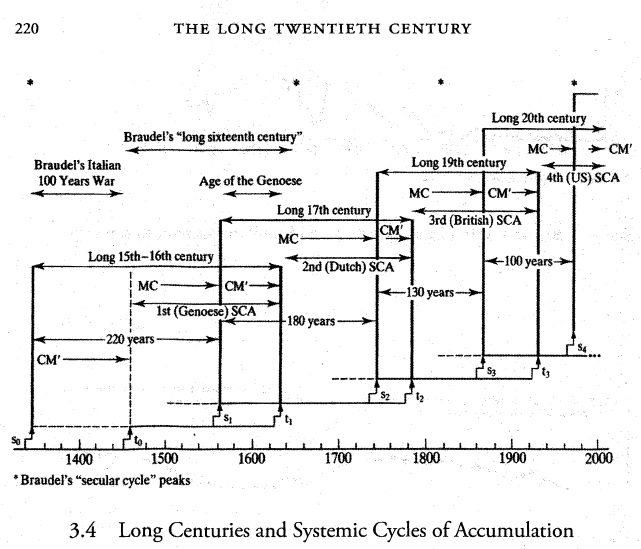
                Arrighi uses the oscillating phases of Marx’s MCM’ formula throughout the text to continue to explain the development of “material expansion” versus “financial expansion.”  Material expansion finds its highest levels of success in (MC) phases of production, where “the capitalist world economy grows along a single developmental path,” while financial expansion sees success only after “the established path has attained or is attaining its limits, and the capitalist world economy shifts through radical restructurings and reorganization onto another path.”[viii]  It is precisely these “radical restructurings and reorganization” that direct Arrighi towards his sense of historical agency.  Examining the three major hegemonies of historical capitalism, Arrighi draws on the dynamic shifts—both internal and external—to the capitalist world system under, first, the Italian City-States during the Renaissance, second, the rise of Dutch trading and its supremacy under the English/British, and third, the global hegemonic order established by the United States.
                Mixed into the shifts of capital investment during this time, however, Arrighi does take the time to address periods of state-formation which highlight the various regime orders that existed throughout capitalism as a world-system.  In doing so, he makes some very powerful observations and arguments by building off the works of Wallerstein and Janet Abu Lughod.  By discussing the development of capital alongside state-formation, Arrighi coaxes the reader into the notion that the two are directly linked; a prime example being his explanation of why Europeans discovered America:
“It follows that the expected benefits for Portugal and other European states of discovering and controlling a direct route to the East were incomparably greater than the expected benefits of discovering and controlling a direct route to the West were for the Chinese state.  Christopher Columbus stumbled on the Americans because he and his Castilian sponsors had treasure to receive in the East.  Cheng Ho was not so lucky because there was no treasure to retrieve in the West.”[ix]
Following Arrighi’s logic to its natural conclusion, the “West was won” by simply a matter of beneficial economics working through the powers and accumulated wealth of states.  It should not be considered, however, that Arrighi is suggesting that agencies of capital and agencies of statehood operate on the same motives, nor that states themselves always operate on the same developmental path.  In fact, Arrighi splits the motives for power into two categories.
                “Capitalism,” for Arrighi, represents the first and primary strategy for state-formation and “logic of power.”  It is contrasted with “territorialism,” which seeks “control over territory and population.”  The "territorialist" logic of power utilizes mobile capital and the flexibility of exchange as a means to an end: “mobile capital [is] the means of state- and war-making.”  For the "capitalist" logic of power, “the relationship between ends and means is turned upside down….and control over territory and population” become the means for advancing capital return.[x]  This not only explains the aforementioned example of how the West was “won,” but also the variances of state formations throughout the world-system in all its regions; the Core, the Semi-Periphery, and the Periphery (Third World).
                Arrighi concludes his text by reminding readers of the persistent crises in capitalism as illustrated by former great thinkers.  Rather than perceive "crisis" as a single, history-defining event, Arrighi poses to us the suggestion that crises are not only a recurring tendency of capitalism, but also serve as a self-balancing mechanism which allow flexibility of investment, which then sustain capitalism by handicapping it.  In other words, Schumpeter’s 1941 suggestion that capitalism might survive another prolonged run of development has “been proven right; but the chances are that over the next half century or so, history will also prove right his contention that every successful run creates conditions under which it becomes more and more difficult for capitalism to survive.”[xi]  This further highlights a powerful argument against perceptions of an unfettered, anarchistic capitalism:
“Such an institution could not exist for any length of time without annihilating the human and natural substance of society; it would have physically destroyed man and transformed his surroundings into wilderness.  Inevitably, society took measures to protect itself, but whatever measures it took impaired the self-regulation of the market, disorganized industrial and agricultural life, and thus endangered society in yet another way.  It was this dilemma which forced the development of the market system into a definite groove and finally disrupted the social organization based upon it.”
Tracing the development of historical capitalism across three hegemonic epochs and examining the world-system from the top down (that is, from the Core to the Periphery), Arrighi sets a gold standard for examining world history that could effectively replace the traditional Western Civilizational approach.  For too long history has been a narrative of nation versus nation, people versus people.  Arrighi’s text challenges that perception by examining social order versus social order, and class versus class.  Nations, statehood, and people are the agencies by which social orders and classes act, or cause, history.  Hegel would certainly appreciate Arrighi’s contribution here, as it breaches further away from the “original history” of Herodotus and Livy, the “reflective history” of Braudel and Wallerstein, and instead embodies “philosophical history;” or—to paraphrase Hegel—a strand of history that is both conscious of itself and conscious of its effect on social ideas.


[i] Hegel.  “The Three Methods of Writing History,” in Reason in History: A General Introduction to the Philosophy of History (New York: Bobbs-Merrill Inc, 1953), 3
[ii] Denbo, Seth.  “History as a Book Discipline” in Perspectives on History, Vol. 53, No. 4 (April 2015), 19
[iii] See: Wallerstein, Immanuel.  Historical Capitalism (New York: Verso, 1983)
[iv] Braudel, “History and the Social Sciences” in On History, p. 50-51
[v] Arrighi, Giovanni.  The Long Twentieth Century (New York: Verso, 1993), 1
[vi] Braudel.  The Long Seventieth Century, quoted in Arrighi, 5
[vii] Arrighi, 5
[viii] Ibid, 9
[ix] Ibid, 35
[x] Ibid, 34-36
[xi] Ibid, 325

Wednesday, July 1, 2015

Debate Topic: Is State-Capitalism a valid term?


 I was recently presented with this question on social media, and I felt prompted to respond since I'm currently reading Arrighi's excellent "The Long Twentieth Century" and hopefully going to do a review of it by the end of the week.

It seems as though people discussing the concept of "state-capitalism" mix it up with the overall general argument that "capitalism cannot exist without a state."  Anyone engaging in this discussion/debate needs to realize that these are two separate ideas.  The supposed "inability of capitalism to exist without a state" is an old argument; very old.  So old, in fact, that the philosophers of the 19th century were perfectly capable of accepting this facet, even though they may have supported one side or the other more (state versus capital).  

The other argument, pertaining to the existence of "state-capitalism", is much newer as an argument than the former.  The newer argument extends primarily from two sources:  V.I. Lenin's statements on State-Capitalism as a result of the Russian Revolution, and Raya Dunayevskaya's criticism of the USSR in 1935 by calling it a "capitalist society."  To understand these differences, I've laid out below a general explanation of how A) The first argument can be seen very plainly by simply observing history and B) the second argument has validity, even if it isn't fully correct in its depiction of specific states (USSR in particular).  Most importantly, I offer a definition for "state-capitalism" that rests on the differences between the First and the Second worlds in the capitalist world-system.

Capitalism manifests itself in various ways dependent upon not the whims and desires of those in reign of its controls, but rather upon the conditions and historical situation of geographic regions.  In the West, as the dominant Core of the capitalist world-system, it manifested a polarity between the State and the capitalist "class": The two are not the same, but they both serve the same interests. Giovanni Arrighi called the difference between the two a separation of "power ideology."  But Arrighi was referring specifically do the different approaches made by state power (West versus East, and England + France versus Spain).  I however, will use it to explain the duality between "state" and "capital."

The state operates on a primarily "territorialist notion of power"; meaning that it seeks to expand itself and bring more physical territory as well as people into its domain. Its support for capitalism is a means to an end: It allows capitalistic endeavors to occur provided that it ultimately yields more territorial control (both within and outside of its direct sovereign).

The capitalist class, however, operations on a "capitalistic notion of power"; meaning that it seeks to expand its accumulation of capital. In this, the State and its territorialist endeavors are the means to the end: The capitalist class supports the State to the extent that it ultimately yields more profits and concentration of resources.

It is here where the "unity" of State and Capital are made overt, but also blurred by ideological frameworks (such as saying the US is "state-capitalist" but France "isn't").

Consider how the United Provinces formed a loose alliance that allowed wars to continue between the states but agreements prevented a disruption of trade. This was a dual process: The state, dependent upon the profits made via trade (to expand its territory), prevented disruption of the economic order...not because they thought it was a good idea....but rather because the capitalistic class--the "monied elite"--would never have gone along with it. This class, however, was more than willing to support a State's war efforts if it ultimately yielded more accumulated capital.


Ultimately, what we see is that these two groups--not united--are engaged in two separate "power processes" that happen to overlap with regard to the MEANS by which each group obtains (or gets closer to) its goal.  The difficulty lies in determining at what point which "means to an end" is exerting dominance. In other words, it's hard to tell if a specific policy or act is the sole derision of "capitalistic" or "territorialist" notions of power.

Now that I've built up this explanation of the polarity occuring in the Core of the capitalist world-system, I shall explain "state-capitalism" as a term:


In the USSR and many other regions of the "Second World", however, there is no polarity between the State and the Capitalist class. There is no separation of power ideology. The goals of the state and those in charge of it are the same. In this sense, it doesn't matter if the nation is territorialist (like China) or capitalistic (like the USSR) in its notion of power; all that matters is that the polarity that exists in the Core (First World) does not exist in the Semi-Periphery (Second World).  As such, "state-capitalism" is a perfectly acceptable term to apply to Second World powers such as the USSR and China---they are not Western Capital bastions and they are not engaged in a dual process of power.


The big question, for those who regularly read this blog, is "what does this have to do with American Communism?"  Well, for one, it should be noted that the term "state-capitalist" has been used in reference to the United States since the 1980s.  This alone presents a conundrum:  How can the term which applies to nations that have no polarity between "capital" and "the state"...also apply to a nation from the Core where there *IS* the polarity?  The direct answer is:  You can't.

If I've tried to make anything clear, it's that "state-capitalism" as a term applies specifically to a nation where the aforementioned polarity does not exist, and power is wielded unilaterally by a single group.  What makes this group "capitalist" is not their position in the government, but rather their existence within a capitalist world-system.  There is no escaping a world-system that has come to entrench itself on all corners of the globe.  If we lived in a socialist world-system, then the term "state-socialist" would equally apply to a nation where there is no distinction between "the workers" and "the state."

American Communism, as a movement, has been historically resistant to the depiction of Core nations as endemic of "state-capitalism"---instead, it has typically been the argument that the capitalistic class (the bourgeoisie) are in control of everything.  It has also been common for American Communists to label politicians and leaders within the Core as subservient and slaves to the capitalistic class.  This suggests not capitalism, nor democracy, nor state-capitalism; it suggests an oligarchy.

Far be it from me to tell people what they should think and define; but American Communism has an overt tendency to dramatize terminology for the sake of rectifying pre-conceived notions of power and hegemony.


For further reading, I'd recommend:

Wallerstein, Immanuel. "Historical Capitalism"
Arrighi, Giovanni. "The Long Twentieth Century"
Harvey, David. "The Limits of Capital"

---

Wednesday, June 17, 2015

American Communism: A Continental Affair

American Communism as a topic can seem paradoxical in a few ways.  For one, it overtly seems strange to associate the adjective "American" with the noun "Communism."  But there are deeper paradoxes; such as the notion that Communism can exist in America as a genuinely "American" concept--isolated from the Soviet Union and the international Communist movement.  There is also the dynamic of multiple "communisms" existing in America, represented by a series of organizations:  The Socialist Party of the USA, the Communist Party of the USA, the Revolutionary Communist Party, and the Communist Party of Canada.

At this year's 2015 North American Labor History Conference (nalhc.wayne.edu), it looks like there will be a panel dedicated to Communist activism in North America.  Even better, it seems that we might have direct insider commentary on the panels.  This puts American Communism into what I consider to be a new perspective; one that includes Communism across all of North America.  But why stop there? 

We could go further, and link socialist movements in Latin America to the overall theme of American Communism.  Why?  Because socialist movements on the American continents were unique affairs; merely framed contextually by the Cold War between East and West.  Who are we, for example, to deem the socialist movements of Latin America and the United States as solely the result of foreign influences?  How are we to conclude, absolutely, that socialist campaigns could not originate from the specific conditions of American societies?

It is my view that we cannot do these things without simultaneously denying the whims and desires of local populations.

Wednesday, June 3, 2015

The Third Law of Dialectics: HM 101.3

It's time yet again for a short exposition on historical materialist philosophy to encounter and understand one of the most important general laws of dialectical logic:  The third law, that of the negation of the negation.  We touched on the first two laws in HM 101.1, but before moving onto a full explanation of the third law, I thought it necessary to emphasize the limitations of Aristotelian logic.  Doing so should help the reader rid themselves of the oversimplified perception of a static and unchanging universe, which will then help them cope with the antithesis of this logic, presented by the third rule.


The third rule, put in strict terminology, is as follows:

3)  The Law of the Negation of the Negation:  The logical growth and extension of past conditions, quantitative and qualitative, into a new state which renders the old both irrelevant and meaningless.

As was stated in 101.1, the third law represents merely the suggestion that the history established by the first law and explained by the second is shown, by the third, to have no terminal "end point".  But consider the true implications being suggested by this law:  It is a complete an utter rejection of all forms of 'constants', 'coincidences', 'luck', and 'happenstance.'  In short, there is not only a meaning behind all developments, but that this meaning itself is not static and unchanging; rather 'meaning' moves, changes, and fluxes in the same manner that existence does.

The third law suffers from one negative drawback; it is hinged upon 19th century German terminology.  This is in part a byproduct of Russian socialists failing to generate their own socialist culture and thus their own meanings, but it is also in part because the most influential early writers of dialectical theory were all German.  However, the language can be put into more familiar terminology without much difficulty.

The word 'negation' refers to the rejection or replacement of an old condition with a new condition.  As established by the second law however, this replacement is not isolated; rather it is dialectically interwoven by quantitative and qualitative changes.  Hegel used a flower to describe this process:

A seed is 'negated' by the sprout.  The sprout is then 'negated' by the stem.  The stem further 'negated' by the bud.  Finally, the bud is 'negated' by the flower, which finalizes itself as the true expression of the plant.  However, despite this constant process of negation, the seed, the stem, and the flower all remain part of the same organism:  a plant.

Thus the emergence of every new quality and/or state constitutes a 'negation' of something that was previously present.  The point of the third law, in using the term twice, is that the story does not end with the death of the plant.  The death of the plant is itself a negation, and during the course of the plants life it typically generates seeds to justify its own negation.  As such, the plant lives on, so-to-speak, through its generational contributions.

It is very important, when considering the totality of these laws, that they are presented as conclusions arrived at through empirical, factual evidence found at all levels of existence.  They are not presented as opinions or as "a priori principles, whose truth or validity is independent of their existence."  Rather they are presented as facts of existence to which we all subjectively relate.

Consider the physical law of gravity.  Gravity is a concept that people understood long before it was calculated with precision and given a direct origin.  Newtonian physics became the standard explanation for what people previously understood through their subjective relativism.  Historical materialism, through its three primary laws of dialectics, makes the same assertion for social and mental development:  It is merely an explanation, in scientific language, for conditions and experiences that we are all aware of....but have only been aware of in a relative and subjective sense; like gravity before Newton gave it a definite name and a definite origin (which itself boils down to the mere existence of something: matter).

Most importantly, and certainly more important than the relativistic nature of thought, is that though these laws are regarded as empirical generalizations; it is not to be claimed that the specific laws can be identified at any particular moment, that contradictions and qualitative shifts can be both observed and declared in the same instant.  In short, the laws of change at each level cannot be predicted.  The existence of change as a constant can be accepted in general, but the specific content of the contradictions within a particular change cannot be stated in advanced or revealed as some determinist truth.

Like all of science, investigations do not take place in a methodological vacuum.  They have a guide and a perspective, and this guide must come from a summation of what has been empirically observed to be true.  As Somerville explained, "The Marxist does not seek to replace nor add something to the scientific method.  He instead seeks to base himself on what is contained within it."

Hope you enjoyed.

Monday, June 1, 2015

Historical Materialism 101.2

"Poverty is the parent of revolution and crime."
-Aristotle, from "Politics", Book II

This is a well known, well liked, and heavily shared quote from Aristotle in his 2nd major work on political economy.  It's liked primarily because of its simplicity and its use of formal logic to convey this simplicity in a manner that most people can understand quickly, without re-reading.  It is a general statement about why people revolt against conditions, and why people engage in what the State deems as 'criminal behavior'.  Without carefully considering the logic behind the message however, it is easy to fall victim to Aristotelian "oversimplifications", as some philosophers have called them, with respect to the elements of history, causality, and creation.

Let's consider Aristotle's proposition here combined with his typical "formal" logic. It is necessary to approach Aristotle's conclusion beginning with his own logic, and then to show the oversimplification made which fails to express the full story.

Poverty, according to Aristotelian logic is one definite thing and cannot be anything else.  (A = A).  Simultaneously, Poverty is incapable of being two things at once (it cannot be poverty and non-poverty; Any X can only be A or non-A, but not both).  The same must be concluded of the other terms used; 'parent', 'revolution', and 'crime'. Formal logic tells us that these categories are and have always been; the reasoning resulting from Platonic idealism:  Their 'existence', so-to-speak, derives from our thinking about them.  We observed their existence and gave them meaning; a meaning whose existence in our own minds is greater than the physical existence of the 'things' in question.

If this is true, according to Aristotle, then the word 'parent' most certainly fits as an application, or a bridge, between isolated categories:  The words 'poverty', 'parent', 'revolution', and 'crime' all exist as separated, static categories that are fundamentally "unchanging" according to Aristotle.  Revolution is revolution; crime is crime, and poverty is poverty.  The linkage between these is the 'parent', which also sits outside the categories of all other terms used.

Poverty is the 'parent' in the sense that it 'creates' revolution and crime.  The concept of 'creation' here is key for Aristotelian logic.  The creation of these two sub-components, 'revolution' and 'crime', appears to happen out of nothingness.  The key word that Aristotle does NOT use, and would never use, is 'cause'. 'Poverty', according to Aristotle, did not CAUSE 'revolution' and 'crime', it CREATES it; just like your parents created you, and like how the Gods created man.

The historical materialist however has history as the basis of causality.  For the dialectician, there is no such thing as 'unchanging forms' and 'static categories' that retain absolute meanings and references.

Consider the following:  'Poverty' CAUSES 'revolution' and 'crime'.  This sentence is wholly different from Aristotle's in that there is a timeline; a history.  We begin at one point (A= Poverty), and we move into another point (B=Revolution and crime); the shift made possible not by a single instant of creation, but rather through a process of causality; of progress; of development.

In this sense, 'Poverty' is not static, unchanging, uniform.  Rather, 'Poverty' is something that naturally transitions (as a material state of existence) into a new form of existence; that being a 'revolutionary' and a 'crime-ridden' existence.  The previously-suggested 'unmoving' categories of 'poverty', 'revolution' and 'crime' are suddenly shown to have a direct connection with one another...and there is no need for a third static-party, the 'parent', to act as the 'creator' of something out of nothing.  Rather, poverty does not create anything...it causes forces already in motion to act upon one another to shift into a new condition:  that of revolution and/or crime. Hope you enjoyed 101.2.  More to come.